Using air temperature and humidity level which taken during the survey all data point were drawn on psychometric chart. Then those point were compared with thermal comfort range according to the ASHRAE standard. According to ASHRAE standard comfort zone range for humidity 20-60%, while temperature range 19 to 24.5 0C, 22 to 26.50C for winter and summer seasons respectively. In Sri Lanka there are not recommended value ranges for the thermal comfort zones so data taken from the survey were compared with ASHRAE standard thermal comfort zone. The psychometric chart is below.
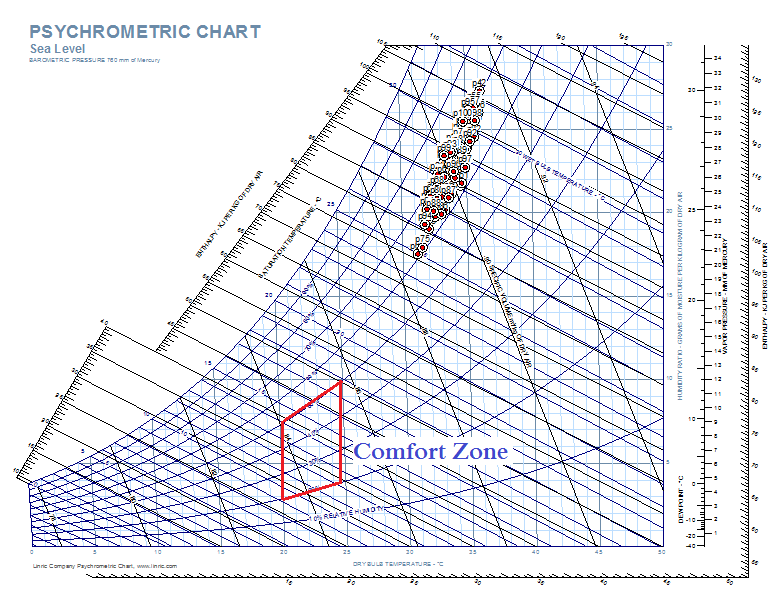

As can be seen from the figure the data which taken from the survey were far away from the thermal comfort zone according to the ASHRAE standard. To carry out those points into the comfort zone temperature as well as humidity inside the bus cabin has to be reduced in considerable value. 

CONCLUSION

The project was carried out to analyze current thermal comfort of bus passengers in Sri Lanka in order to improve thermal comfort level further. Controlling outside parameters such as air temperature, air velocity, sun radiation is almost impossible where all the parameters could be controlled in a proper manner inside the bus cabin. Shortcomings and limitations of existing models, specially the limitations when adapting those models to Sri Lanka were discussed with related information. It was obvious that the accepted ranges of existing models did not match with the climatic conditions in Sri Lanka, it were far away than minimum requirements and it was a deleterious despite of the region.

Main drawbacks of the survey were identified. It can be stated that this study can be further improved by taking more samples representing different cultural backgrounds, observing different areas, and taking some more time for the higher accuracy of the results. Especially all the parameters could be measured by using further advanced measuring instruments and methods in order to achieve better results and smooth analysis.